
Eight Field Knots You’ll Actually Use
Why Knots Matter
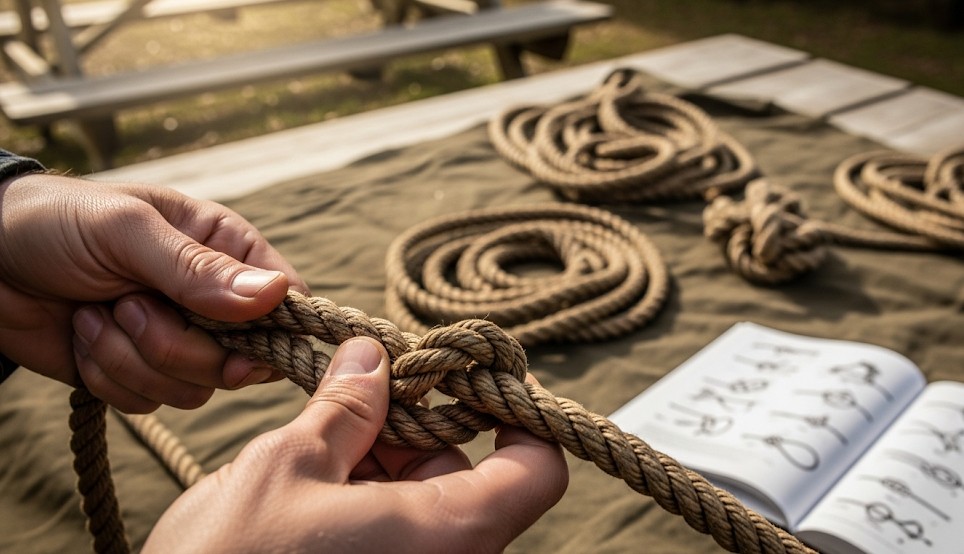
Knots are one of the most useful low-tech survival skills. A few reliable knots can help you build shelters, repair gear, secure loads, tension ridgelines, improvise stretchers, hang food, and manage countless camp tasks.
Most people do not need to memorize dozens of complicated knots. In reality, a small set of versatile knots covers the vast majority of real-world outdoor and emergency situations.
The goal is not to become a sailing expert. The goal is to tie a handful of knots quickly, correctly, and under stress.
Objective
Learn eight practical knots that handle most field tasks involving shelter setup, tensioning, repairs, hauling, and securing equipment.
What Makes a Good Field Knot?
Good field knots should:
- Be fast to tie
- Work reliably under load
- Be easy to inspect visually
- Untie without excessive struggle
- Function in wet, cold, or low-light conditions
Simple and dependable beats fancy and complicated.
1. Bowline
The bowline creates a fixed loop that does not tighten under load.
Best Uses
- Shelter anchor points
- Rescue loops
- Securing gear
- Attaching rope to objects
Why It Matters
A properly tied bowline stays secure while remaining relatively easy to untie after heavy tension.
Many outdoors people consider it one of the most useful knots ever created.
2. Figure-8 on a Bight
This knot forms a strong fixed loop in the middle or end of a rope.
Best Uses
- Load-bearing loops
- Climbing systems
- Anchor points
- General secure loop creation
It is easy to inspect visually and maintains excellent strength.
3. Clove Hitch
The clove hitch quickly secures rope around poles, trees, or posts.
Best Uses
- Tarp corners
- Temporary anchors
- Camp setup
- Quick tie-offs
It is fast and adjustable but should be backed up if used under shifting loads.
4. Trucker’s Hitch
The trucker’s hitch creates mechanical advantage for tightening lines.
Best Uses
- Tarp ridgelines
- Securing cargo
- Tight shelter setups
- Equipment lashing
This knot is one of the best tensioning systems for field shelters.
Basic Concept
- Create a loop in the standing line.
- Run the free end through the anchor point.
- Feed it through the loop.
- Pull tight for mechanical advantage.
- Finish with half hitches.
5. Prusik Knot
The prusik is a friction hitch that grips when loaded and slides when unloaded.
Best Uses
- Adjustable tarp tensioners
- Backup climbing systems
- Improvised ascenders
- Ridgeline management
Smaller cord is normally used around a larger rope.
6. Sheet Bend
The sheet bend joins ropes of different diameters.
Best Uses
- Extending lines
- Emergency rope repairs
- Joining different cord sizes
It performs better than many common knots when rope sizes do not match.
7. Zeppelin Bend
The Zeppelin Bend creates a strong, secure connection between two ropes.
Why People Like It
- Very secure
- Stable under heavy load
- Easier to untie than many bends
It is an excellent knot for permanent or semi-permanent rope joining.
8. Half Hitch + Stopper Knot
Half hitches secure loose ends and finish other knots safely.
Best Uses
- Finishing tension systems
- Preventing slippage
- Temporary tie-offs
- Quick camp tasks
Many good knot systems fail because people skip the finishing steps.
Recommended Cordage
Different cord sizes work better for different jobs.
- 3 mm cord: prusiks, tarp adjustments, lightweight tasks
- 5–7 mm cord: general utility
- 550 paracord: versatile all-around field cordage
- Static rope: shelter ridgelines and hauling systems
Practice in Real Conditions
Knots become harder when:
- Hands are cold
- Gloves are worn
- It is dark
- Rope is wet
- You are tired or stressed
Practice outdoors instead of only indoors at a desk.
Real Example
During a windy overnight camp, a tarp shelter secured with trucker’s hitches and adjustable prusik knots stayed tight through shifting wind and heavy rain. Nearby shelters tied with weak or poorly tensioned knots required repeated adjustment overnight.
Common Knot Mistakes
- Using the wrong knot for the task
- Failing to dress the knot properly
- Leaving tails too short
- Skipping backup hitches
- Overcomplicating simple jobs
Most knot failures come from poor tying habits rather than the knot itself.
Simple Weekly Drill
Tie each knot 10–20 times this week.
- Practice slowly first.
- Focus on consistency.
- Then practice while standing, wearing gloves, or under low light.
Teaching another person is one of the fastest ways to remember knot systems long-term.
Final Thoughts
You do not need a giant knot encyclopedia to be effective outdoors. A few dependable knots solve most real problems.
Build muscle memory with practical knots you will actually use, and they become valuable tools for shelter building, repairs, hauling, and emergency fieldcraft.
Learn These Knots Visually
Knot skills improve much faster when you can watch the tying process in motion. For animated step-by-step knot demonstrations, visit AnimatedKnots.com .
Their visual guides are especially useful for practicing the bowline, trucker’s hitch, prusik knot, and figure-8 variations covered in this article.
← Previous | All Articles | Next →