
Signaling from Remote Locations Without Electronics
Objective
When electronics fail, signaling becomes a practical survival skill. The objective is to attract rescuers using contrast, motion, geometry, sound, smoke, light, and location choice without depending on powered devices. A phone, GPS messenger, radio, or flashlight may be excellent tools, but batteries die, devices break, and water has a long history of bullying electronics.
Good signaling is not random shouting or waving. It is about creating something that looks unnatural from a distance and repeats a clear distress pattern. Straight lines, sharp contrast, repeated groups of three, reflective flashes, smoke columns, and deliberate sound patterns all stand out because they do not normally appear in the wild.
Scenario (Example)
Example: Electronics failed after a river dunk. You are in a valley with occasional aircraft overhead, a gravel river bar nearby, thick trees along the bank, and limited energy. Your priority is to move to a visible location, build a large ground signal, prepare reflective signaling, and create sound signals that can be repeated without exhausting yourself.
If the emergency began during a river crossing, review How to Cross a River Safely for prevention and recovery lessons. Water hazards often create both injury risk and communication failure.
Stay or Move?
Before building signals, decide whether to stay in place or move to a better signaling location. If people know your route, staying near your planned path may improve rescue odds. If you are hidden under dense canopy, in a canyon, or below a steep bank, moving a short distance to a meadow, ridge, beach, gravel bar, road, or open slope may make a major difference.
- Stay near your last known route if rescuers are likely to search there.
- Move only if you can do so safely and mark your direction.
- Choose open areas visible from the air or nearby travel corridors.
- Avoid using all your energy chasing sounds, lights, or aircraft.
- Leave arrows or markers if you relocate from your original position.
If navigation is uncertain, do not wander blindly. For orientation skills, see Navigation 101: Map, Compass, Confidence .
Visual Ground Signals
Large ground signals are effective because they continue working while you rest. They should be big, simple, and high-contrast. A small SOS made of sticks may look clear from five feet away but disappear from the air. Bigger is better.
- Create large straight lines using logs, rocks, clothing, branches, snow, or scraped ground.
- Use SOS, HELP, X, or a large arrow pointing toward your location.
- Build signals in open areas such as gravel bars, beaches, meadows, snowfields, or clearings.
- Use light materials on dark ground or dark materials on snow, sand, or pale rock.
- Refresh the signal after wind, rain, snow, or animals disturb it.
Three of anything is commonly understood as distress: three fires, three piles of stones, three blasts, three flashes, or three repeated signals. The pattern matters because it looks intentional.
Motion Signals
Motion catches the eye better than a still object. If you hear aircraft, vehicles, boats, or people, use controlled movement rather than frantic movement.
- Wave a high-contrast cloth slowly and repeatedly.
- Use a bright tarp, jacket, bandana, or emergency blanket.
- Move side to side in an open area rather than under trees.
- Avoid exhausting yourself by waving nonstop when no one is nearby.
Keep a signaling item ready instead of buried in your pack. If a helicopter, aircraft, boat, or search party appears suddenly, you may only have seconds to stand out.
Mirrors & Reflectors
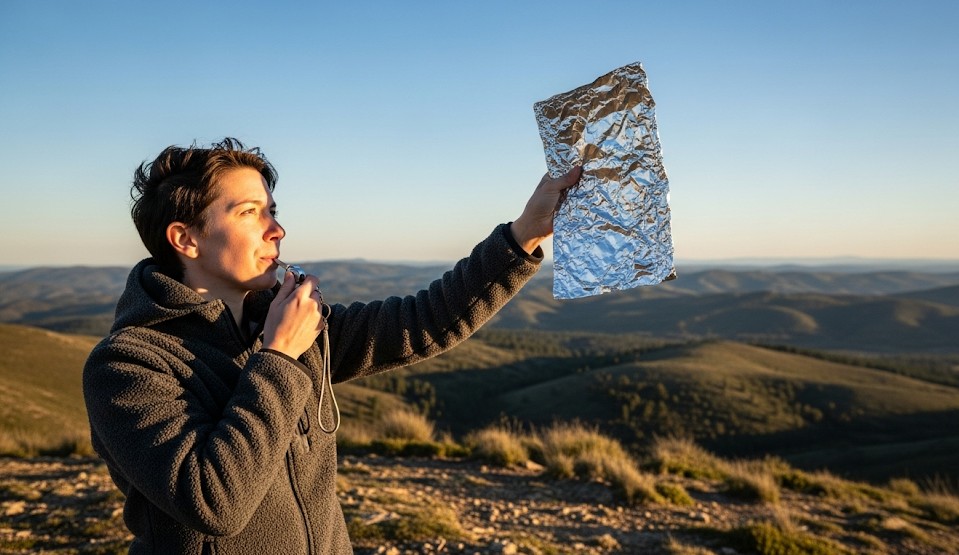
Reflective signaling can be visible at surprising distances when sunlight is available. A dedicated signal mirror is ideal, but foil, a phone screen, metal lid, shiny emergency blanket, or polished object may work in a pinch.
- Face the sun and catch light on the reflective surface.
- Form a V with two fingers and place the target between them.
- Aim the reflected flash through the V toward the aircraft, boat, or search team.
- Sweep slowly across the target path rather than holding perfectly still.
- Repeat flashes in groups of three when possible.
Morning and evening sun angles often produce strong flashes. Midday can still work, but aiming may be harder depending on terrain and target direction.
Sound Signals
Sound is useful in forests, canyons, fog, or low-visibility conditions. A whistle is far better than shouting because it carries farther and uses less energy.
- Use three short whistle blasts, then pause and repeat.
- Bang on hollow logs, rocks, metal bottles, or cookware if a whistle is unavailable.
- In canyons or valleys, use echoes to your advantage.
- Save your voice; shouting constantly can cause fatigue and dehydration.
Sound works best when repeated at intervals. Listen after signaling. A faint reply may be easy to miss if you immediately start moving or making more noise.
Smoke, Fire, and Night Signals
Smoke can be effective during daylight, especially in open terrain. Fire can also provide light at night, but it must be controlled. Do not start a wildfire while trying to get rescued. That is the kind of “extra visibility” nobody asked for.
- Use three small fires in a triangle or line if conditions are safe.
- Add green vegetation carefully to create smoke once flames are established.
- Keep water, soil, or sand ready to control the fire.
- At night, use firelight, reflective material, or repeated flashes from a light if available.
- Never build signal fires in unsafe wind, dry grass, or restricted fire conditions.
If you need emergency shelter while waiting for rescue, review Building a Shelter from Natural Materials . The best signal plan still needs warmth, rest, and protection from weather.
Location Strategy
Signal placement matters. A brilliant orange panel hidden under trees is less useful than a simple arrow on a bright gravel bar. Searchers look along routes, shorelines, ridges, trail corridors, river bends, open slopes, and last known locations.
- Move signals to open ground whenever safely possible.
- Use arrows to connect your shelter location to visible open areas.
- Place signals where aircraft or ground teams are likely to scan.
- Keep your shelter close enough that you can respond quickly.
- Do not separate too far from your main signal unless necessary.
In cold, hot, or wet conditions, balance visibility with survival needs. A visible location that exposes you to dangerous weather may require a nearby sheltered position and a separate signal area.
Real Example
A stranded paddler lost electronics after capsizing and reaching a gravel bar. Instead of staying under dense riverside trees, they laid a large arrow from driftwood on the open bar, placed a bright item at the arrow point, and used a foil packet as a mirror when aircraft noise was heard. A rescue helicopter spotted the signal during a pass because the arrow and reflection were visible against the pale gravel.
Common Mistakes
- Making signals too small to see from the air.
- Using colors that blend into the background.
- Leaving the signal area for long periods without marking direction.
- Wasting energy shouting instead of using a whistle.
- Building fires in unsafe conditions.
- Failing to prepare signals before aircraft or rescuers appear.
- Moving away from the last known route without leaving markers.
Checklist
- High-visibility panel, tarp square, or bright clothing
- Emergency space blanket
- Whistle
- Signal mirror or reflective foil
- Fire-starting kit where safe and legal
- Knife or tool for cutting branches and making markers
- Headlamp or flashlight with spare batteries
- Marker tape or natural arrows where appropriate
- Compact emergency shelter
Many of these items belong in a basic emergency kit. For a broader packing list, see Top 10 Items for Your First Bug-Out Bag .
Contingencies
- No sun: Emphasize geometry, contrast, sound, and smoke if safe.
- Dense canopy: Move to river bars, meadows, ridges, beaches, roads, or clearings when safe.
- Nightfall: Prepare reflective material, controlled firelight, or repeated light flashes.
- Injury: Build signals close enough to your shelter that you can maintain them without worsening the injury.
- Bad weather: Secure signals against wind and refresh them after rain or snow.
After-Action
After any trip, drill, or close call, review what signaling tools you actually had available. Did you have a whistle? Was the mirror easy to reach? Was your bright panel large enough? Could you make a visible ground signal quickly? Add missing items to your kit and practice using them before the next trip.
Signaling is not about panic. It is about making yourself easy to notice. Use contrast, repetition, motion, sound, and smart location choice. When batteries die, your best rescue tool may be a bright cloth, a whistle, a mirror, and the discipline to stay visible instead of wandering deeper into the problem.
← Previous | All Articles | Next →