Staying Safe in Civil Unrest
Objective
Civil unrest can change the safety of a neighborhood, commute, workplace, or public event very quickly. The objective is to move, shelter, or evacuate safely during protests, riots, crowd surges, or public disorder while minimizing exposure and avoiding escalation. This is not about taking sides, arguing, recording drama, or testing your courage. It is about getting yourself and your group away from danger with the least attention possible.
Most people caught near unrest are not looking for trouble. They are commuters, workers, visitors, residents, or bystanders who happened to be in the wrong area when conditions changed. Good planning helps you avoid choke points, stay calm, communicate clearly, and make conservative decisions before the crowd or situation forces those decisions for you.
Scenario (Example)
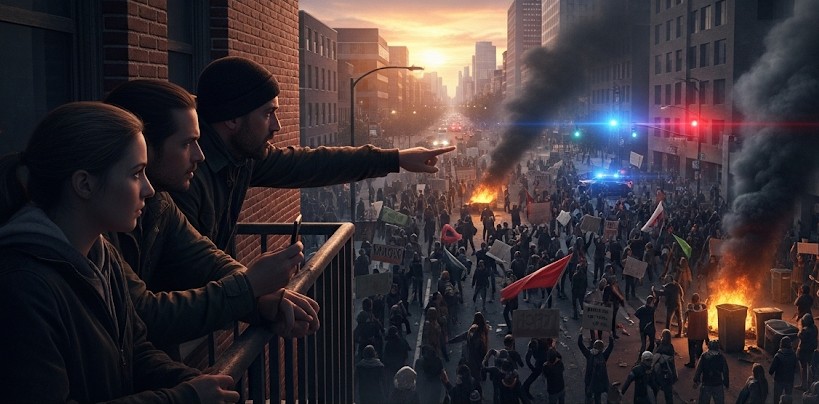
Example: Demonstrations turn volatile near your workplace. Transit service pauses, crowds gather along your normal route home, police lines block several intersections, and your preferred parking area is now inside the affected zone. You are with one coworker, both phones are working, and you need to decide whether to shelter in place, move to a safer building, or leave the area by an alternate route.
In this situation, the safest route may not be the shortest route. The priority is distance from volatility, not speed. If you also need to secure a home or office during a disruption, review Power Outage Security Measures and How to Barricade a Door in a Pinch .
Pre-Movement Checks
Before leaving a safe location, slow down and prepare. Many mistakes happen because people step outside without checking conditions, battery level, route options, or what they are wearing.
- Dress neutral. Avoid logos, political symbols, team colors, tactical-looking clothing, or anything that attracts attention.
- Wear closed-toe shoes suitable for walking several miles.
- Secure backpack straps and remove dangling items that can snag or be grabbed.
- Carry ID, a little cash, essential keys, and necessary medications.
- Charge your phone and carry a power bank if available.
- Share your intended route and destination with a trusted contact.
- Check local alerts, transit status, and road closures before moving.
Keep your hands free when possible. A small crossbody bag or secured backpack is usually better than carrying loose items. Avoid looking like you are carrying valuables.
Route Strategy
Route planning during unrest is about avoiding friction. Crowds, police lines, barricades, bridges, tunnels, narrow sidewalks, and transit stations can all become choke points. Move around trouble, not through it.
- Use parallel streets one or two blocks away from the main avenue.
- Avoid bridges, tunnels, fenced corridors, and narrow alleys unless you know they are clear.
- Stay away from police lines, barricades, burning objects, and active confrontations.
- Move in pairs or small groups when possible.
- Choose rendezvous points before movement begins.
- Identify safe lobbies, hotels, hospitals, fire stations, or public buildings along the route.
- Do not stop to film or argue. Curiosity is not an emergency plan.
If transit is down, consider walking away from the affected zone before requesting rideshare or pickup. A pickup point one or two miles away may be safer and faster than waiting at the edge of a volatile crowd.
Low-Profile Movement
Blending in does not mean pretending to be part of a crowd. It means avoiding behaviors that make you noticeable, confrontational, or vulnerable.
- Walk calmly and purposefully.
- Keep your head up and scan ahead without staring aggressively.
- Avoid chanting, arguing, filming, or engaging with confrontations.
- Keep valuables out of sight.
- Do not wear headphones in both ears.
- Cross streets early if you see tension ahead.
- Leave before the atmosphere changes from tense to chaotic.
If you feel the crowd beginning to compress, move diagonally toward the edge instead of fighting directly against the flow. Avoid falling. In a dense crowd, staying upright is a major safety priority.
De-Escalation
If approached or challenged, your goal is to disengage safely. Keep statements short, neutral, and non-threatening.
- Keep hands visible and movements slow.
- Use a calm voice.
- Avoid insults, sarcasm, political arguments, or sudden gestures.
- Use simple statements: “I’m just leaving,” “I don’t want trouble,” or “I’m moving that way.”
- Do not touch, shove, or grab unless absolutely necessary for safety.
- Create distance gradually rather than turning your back and sprinting.
De-escalation is not about winning a debate. It is about leaving with all your teeth, your phone, and your blood pressure mostly where it started.
Irritant Exposure
Chemical irritants can affect eyes, skin, breathing, and panic level. If you are exposed, leave the affected area as quickly and calmly as possible.
- Move upwind and away from the source.
- Do not rub your eyes.
- Blink repeatedly and flush with clean water if available.
- Remove contact lenses as soon as safe.
- Remove contaminated outer layers when possible.
- Avoid oils, lotions, or creams that may trap irritants on skin.
- Seek medical help for breathing problems, severe pain, asthma issues, or prolonged symptoms.
Carry water for drinking first. Do not use all water for flushing unless necessary. During urban disruption, water access may become unreliable. For related planning, see Finding Water in a City During Emergencies .
Shelter-in-Place
Sometimes the safest move is not moving. If unrest is outside and your current location is secure, sheltering in place may be better than entering the street.
- Move to an interior room away from windows.
- Keep lights low and blinds closed.
- Lock doors and avoid unnecessary entry or exit.
- Stay away from glass, balconies, and street-facing windows.
- Keep phones charged and notifications on for emergency alerts.
- Do not drive around to “see what is happening.”
- Park vehicles in a garage, driveway, or off-street location if safe.
If the situation overlaps with a blackout, review Surviving a Blackout: Home Checklist and Blackout Cooking with Common Household Items .
Communication Plan
Communication often becomes unreliable during large events. Networks may be overloaded, batteries drain, and people may separate.
- Text instead of calling when networks are congested.
- Use short messages: location, status, destination, next check-in time.
- Set a primary and backup meeting point.
- Agree on what to do if separated.
- Keep emergency contacts written down in case your phone dies.
- Use offline maps when possible.
For broader information planning when normal channels fail, see Staying Informed Without Internet or TV .
Real Example
Two coworkers leaving a downtown office found their normal train entrance closed and a crowd forming near an overpass. Instead of pushing through the main route, they used side streets two blocks away, avoided a police line, and moved to a hotel lobby outside the immediate crowd zone. They waited there, charged one phone, checked transit updates, and continued home after the surge passed. The key decision was avoiding the choke point instead of trying to beat the crowd through it.
Common Mistakes
- Walking directly toward noise, smoke, or flashing lights out of curiosity.
- Wearing identifiable symbols that draw attention.
- Trying to drive through a crowd.
- Stopping to film confrontations.
- Waiting too long to leave a deteriorating area.
- Separating from your group without a meeting plan.
- Assuming the shortest route is safest.
- Ignoring basic needs like water, medication, and phone battery.
Checklist
- Neutral clothing and closed shoes
- Hat and weather-appropriate outer layer
- Water bottle
- Basic eye protection if appropriate
- Cash and ID copies
- Phone with power bank
- Written emergency contacts
- Small first aid kit
- Offline map or printed alternate route
- Essential medications
For a broader everyday emergency carry mindset, review Top 10 Items for Your First Bug-Out Bag .
Contingencies
- Separated: Move to pre-agreed point B. If unsafe, move to point C and send a short text update.
- Transit down: Walk away from the affected zone before arranging pickup or rideshare.
- Phone battery low: Dim screen, use texts, close unnecessary apps, and preserve power.
- Route blocked: Do not argue at barricades. Backtrack and use a parallel route.
- Injured person: Move to safety, provide basic first aid, and contact emergency services.
- Unrest near home: Shelter away from windows, secure doors, and avoid unnecessary outdoor movement.
After-Action
After the incident or practice review, update your alternate commute map. Mark safe lobbies, hospitals, fire stations, hotels, wide streets, transit alternatives, and areas to avoid. Add backup rendezvous points for family or coworkers.
Civil unrest safety is mostly about avoidance, timing, and calm movement. Leave early when possible, stay neutral, avoid choke points, communicate clearly, and do not let curiosity become your worst tactical decision. The safest story is usually the boring one where you got home without becoming part of the headline.
← Previous | All Articles | Next →